


“AI may be digital, but its growth depends on physical infrastructure. This evidence-based guide explains why HVAC/R, electrical, construction, controls and energy careers matter, where shortages appear, and how young people can prepare.”
AI and skilled trades are often discussed as opposites. One belongs to computers, while the other belongs to tools, equipment and job sites. Heating, ventilation, air conditioning and refrigeration are known as HVAC/R. In reality, the AI era needs both. Every data center, smart building, cold room, power network and automated factory depends on people who can install, test, repair and improve physical systems.
That creates a global career opportunity. It does not mean every trade job is safe from change, and it does not guarantee work in every country. However, strong evidence shows that trained technicians remain essential as AI infrastructure, electrification, cooling and clean energy expand.
AI is changing work, but exposure is not the same as replacement
The International Labour Organization found that one in four workers worldwide is in an occupation with some exposure to generative AI. Only 3.3 percent of global employment sits in the highest exposure category. The ILO also concluded that job transformation is more likely than complete replacement because most occupations still require human input.
The OECD makes an equally important distinction. High AI exposure does not automatically mean high automation risk. Text-heavy and highly digitized work may interact with AI more often, while physical work has lower direct exposure to generative AI. Still, routine manual tasks can face pressure from robotics, prefabrication and other forms of automation.
Therefore, the best question is not, ‘Which jobs can AI never touch?’ A better question is, ‘Which workers combine practical skill, judgement, safety knowledge and digital tools?’ That combination is where AI and skilled trades become a powerful career strategy.
Forbes coverage reached a similar conclusion from an industry perspective. Separate 2025 articles described a strong skilled-trades market and examined how technology and AI are reshaping construction work. Those articles help explain the public conversation, while the official evidence below shows why the opportunity extends beyond one country.
The hidden physical economy behind AI
AI feels invisible because people use it through a screen. Yet the system behind that screen is physical. Data centers need electrical supply, switchgear, transformers, backup power, cooling, ventilation, pumps, pipework, fire protection, controls and round-the-clock maintenance.
The International Energy Agency reports that data centers used about 415 terawatt-hours of electricity in 2024. Its base case projects demand to more than double to about 945 terawatt-hours by 2030, with AI as the most important driver of growth. This forecast is not a direct job count. However, it shows the scale of infrastructure that must be built, connected, cooled and maintained.
Government plans now recognize the link. America’s AI Action Plan calls for faster data-center construction and new initiatives for high-demand occupations such as electricians and HVAC technicians. The United Kingdom created AI Growth Zones to accelerate data-center development. The European Union also aims to triple its data-center capacity within five to seven years.
These announcements do not prove that every project will arrive on schedule. They do show that AI policy is becoming infrastructure policy. As a result, AI and skilled trades meet in power rooms, plant rooms, rooftops, workshops and construction sites.
Global demand signals for AI and skilled trades
The International Energy Agency surveyed more than 700 energy firms, unions and educators for its 2025 employment report. More than half reported critical hiring bottlenecks. The pressure was most acute in applied technical roles, including electricians, pipefitters and power-line workers. The IEA also found that current AI uses do not significantly reduce demand for manual roles in construction, operations and maintenance.
Ageing adds more pressure. Across the energy sector, two out of every three new hires needed by 2035 will replace retiring workers, according to the same IEA report. In advanced economies, 2.4 workers are nearing retirement for every energy worker under 25. Therefore, the opportunity is not based only on new technology. It also comes from replacing experience that is leaving the workforce.
Cooling, heat pumps and regional trade shortages
Cooling provides another global signal. The UN Environment Program projects installed cooling capacity to rise from 22 terawatts in 2022 to 68 terawatts by 2050 under a business-as-usual path. Demand is growing fastest in Africa and South Asia. At the same time, the International Institute of Refrigeration reports that refrigeration employs about 12 million people worldwide but faces a severe shortage of skilled technicians and installers, especially in Europe and North America.
Heat pumps add a third growth path. In the IEA’s future scenario, global employment in heat-pump supply rises to more than 1.3 million workers by 2030, and installation jobs grow the most. These systems need refrigerant knowledge, electrical competence, airflow measurement, hydronics and controls.
Regional sources reinforce the pattern, although their measures are not directly comparable. The 2025 EURES data lists air-conditioning and refrigeration mechanics as a shortage occupation in 16 countries and building electricians in 21. Canada expects a strong national shortage risk for HVAC/R mechanics from 2024 to 2033. Australia’s 2025 list also rates air-conditioning and refrigeration mechanics and general electricians in shortage. South Africa’s 2024 high-demand list includes electricians, plumbers and related technical occupations.
Meanwhile, the World Economic Forum places building construction workers among the five largest-growing job types worldwide by 2030 in absolute terms. Because that figure comes from an employer survey and model, it should be read as a directional forecast, not a guarantee.
Which careers can grow with the AI economy?
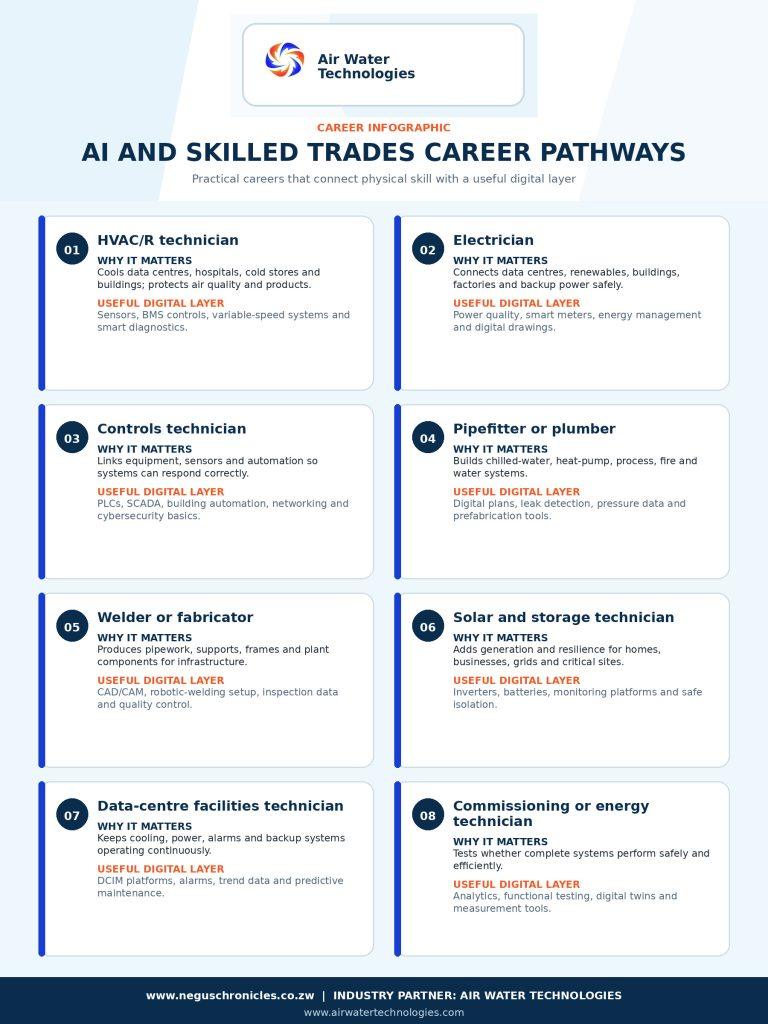
The AI economy needs more than software developers. It also needs people who understand heat transfer, electricity, airflow, pressure, water, mechanical motion and safe installation. The following careers connect physical trade skill with a useful digital layer.
For example, AI and skilled trades create entry paths for people who enjoy solving problems on real equipment.
- HVAC/R technician
Why it matters: Cools data centers, hospitals, cold stores and buildings; protects air quality and products.
Useful digital layer: Sensors, BMS controls, variable-speed systems and smart diagnostics.
- Electrician
Why it matters: Connects data centers, renewables, buildings, factories and backup power safely.
Useful digital layer: Power quality, smart meters, energy management and digital drawings.
- Controls technician
Why it matters: Links equipment, sensors and automation so systems can respond correctly.
Useful digital layer: PLCs, SCADA, building automation, networking and cybersecurity basics.
- Pipefitter or plumber
Why it matters: Builds chilled-water, heat-pump, process, fire and water systems.
Useful digital layer: Digital plans, leak detection, pressure data and prefabrication tools.
- Welder or fabricator
Why it matters: Produces pipework, supports, frames and plant components for infrastructure.
Useful digital layer: CAD/CAM, robotic-welding setup, inspection data and quality control.
- Solar and storage technician
Why it matters: Adds generation and resilience for homes, businesses, grids and critical sites.
Useful digital layer: Inverters, batteries, monitoring platforms and safe isolation.
- Data-center facilities technician
Why it matters: Keeps cooling, power, alarms and backup systems operating continuously.
Useful digital layer: DCIM platforms, alarms, trend data and predictive maintenance.
- Commissioning or energy technician
Why it matters: Tests whether complete systems perform safely and efficiently.
Useful digital layer: Analytics, functional testing, digital twins and measurement tools.
* NB: Career names, licenses and qualification levels vary by country.
However, licensing rules and job titles differ by country. A young person should always check local entry requirements before choosing a course. Still, each pathway rewards the same habit: learn the physical system first, then use digital tools to measure, analyze and improve it.
How AI will change trade work
AI can make a capable technician more effective. For example, it can organize sensor readings, compare a fault history, search manuals, draft a service report or flag an unusual energy pattern. Building-management and industrial-control systems can also use data to detect problems earlier.
However, AI cannot take responsibility for a live electrical panel, a refrigerant leak, an unsafe pressure, a failed bearing or poor airflow. A trained person must confirm the condition, isolate hazards, follow codes, test the repair and decide whether the equipment is safe to return to service.
The strongest technician will therefore combine three kinds of knowledge. First comes trade theory, including cycles, components, wiring, controls and measurement. Second comes practical skill with tools and real equipment. Third comes digital judgement, which means knowing when AI output is useful and when it must be questioned.
Why Africa can turn this shift into a youth opportunity
Africa has the youngest workforce in the world. The World Bank estimates that up to 12 million young Africans enter the job market each year. In Eastern and Southern Africa alone, about 8 million enter annually, while fewer than one million secure wage jobs.
This gap is a serious challenge, not automatic proof of opportunity. Training must connect to real employers, infrastructure plans and local demand. The African Union’s Continental TVET Strategy 2025-2034 puts employability, skills and sustainable development at the center. Its STISA 2034 strategy also calls for more investment in STEM, TVET, infrastructure and workforce skills, with a focus on women and youth.
For Zimbabwe and other African countries, the practical opportunity is wider than building data centers. Hospitals need ventilation and medical refrigeration. Farms and food businesses need cold rooms. Schools, hotels, mines, factories and shops need reliable electrical and cooling systems. Solar, batteries and efficient equipment also need installation and maintenance.
Young people can serve local needs first and later specialize in controls, commissioning, clean energy or critical facilities. In that way, AI and skilled trades can support both employment and essential services.
How to prepare for an AI-era trade career
A strong pathway does not require every student to become an AI programmer. The OECD reports that fewer than one percent of workers will need advanced AI-specific skills. Most workers need solid foundations, useful digital skills and the ability to think critically.
As a result, training for AI and skilled trades should connect the workshop, the job site and the computer screen.
- Build foundations in mathematics, science, reading, technical drawing and communication.
- Choose a recognized trade pathway in HVAC/R, electrical work, plumbing, welding, controls, solar or industrial maintenance.
- Get supervised, hands-on experience through an apprenticeship, workplace placement or structured practical programe.
- Learn safety, test instruments, fault-finding and the codes that apply in your country.
- Add digital skills such as spreadsheets, sensor data, building-management systems, PLC basics and responsible AI use.
- Keep evidence of your work through logbooks, photographs, test results and references, while protecting customer information.
- Develop customer service and business skills because many technicians later supervise teams or start service companies.
Apprenticeships can reduce the cost barrier. US Registered Apprenticeship combines paid work, classroom instruction and a portable credential. In England, apprentices are employees and do not pay tuition fees. Other countries use different systems, so applicants should verify the program, employer and qualification before enrolling.
What governments, schools and employers should do
The opportunity will not become real through career advice alone. Training providers need current equipment, capable instructors and strong employer partnerships. Governments should publish clear shortage data, expand apprenticeships, support recognized certification and remove barriers that keep women and low-income youth out of technical careers.
Employers also have a role. They can sponsor students, provide safe work placements, share equipment with colleges and train experienced technicians to mentor new entrants. The IEA estimates that the global number of graduates entering energy work would need to rise by around 40 percent to prevent the skills mismatch from worsening by 2030.
Finally, policy should connect AI investment to local workforce development. When a country approves a data center, grid upgrade, hospital, cold-chain project or clean-energy plant, the plan should include apprenticeships and supplier training. That turns capital investment into durable local capability.
The balanced answer: Trades are resilient, not untouchable
No honest adviser should promise an AI-proof career. Robotics, remote monitoring, modular construction and smarter equipment will change trade work. Some repetitive tasks will shrink, and technicians who ignore digital systems may lose ground.
Yet physical infrastructure still creates hard problems in unpredictable places. A leaking pipe does not repair itself. A cooling system does not commission itself. A faulty cable, contaminated cold room or unsafe pressure still requires trained human judgement. That is why AI and skilled trades should be viewed as partners, not competitors.
AI and skilled trades belong to the same future
The digital economy runs on physical systems. As AI expands, the world will need more power, more cooling, more construction and more efficient equipment. At the same time, retirements and existing shortages are reducing the supply of experienced workers.
For a young person, the opportunity is clear but demanding: master a real trade, learn modern controls and use AI with judgement. For governments and employers, the task is equally clear: connect investment to training. Done well, AI and skilled trades can create practical careers while building the infrastructure that communities need.
Continue exploring AI and education stories on Negus Chronicles. For practical HVAC/R services and industry information, visit Air Water Technologies.
Frequently asked questions about AI and skilled trades
Will AI replace skilled trades?
AI will change parts of trade work, especially planning, diagnostics and paperwork. Current systems still struggle with varied job sites, physical repairs, safety decisions and legal responsibility. The stronger career plan is to combine a recognized trade with digital and AI literacy.
Which skilled trades may benefit most from AI growth?
HVAC/R, electrical work, controls, pipefitting, plumbing, welding, power-line work, solar and storage, commissioning and data-center facilities all connect to physical infrastructure. Demand will vary by country, project cycle and licensing rules.
Why do AI data centers need HVAC/R technicians?
Servers produce large amounts of heat. Data centers need reliable cooling, airflow, humidity control, pumps, pipework, sensors and backup systems. Technicians install, test and maintain those systems so the equipment can operate safely.
Do I need a university degree to enter a skilled trade?
Not always. Many countries offer TVET programs, apprenticeships, technical certificates or employer training. Some advanced roles may later require higher qualifications. Always check the recognized pathway and licensing rules where you plan to work.
How can a young person in Africa start?
Strengthen maths, science, reading and communication. Visit a recognized TVET college or apprenticeship provider. Ask employers which qualifications they accept. Seek supervised practical experience, learn safety, and add controls, sensors and responsible AI use after building strong trade foundations.
